The Divided Heart
Conflict is Everywhere
Some mornings I don't walk out of the house feeling good.
Some mornings I wake up, look at my phone, and realize I set my alarm for 6 PM instead of 6 AM. Which means I didn't set an alarm. Which means I'm now late. Which means that quiet, unhurried morning I had planned, Bible, coffee, a few minutes to think, is just gone. Completely gone. And I'm now doing a full sprint through the house trying to compress about thirty minutes of preparation into about 4.
And if you've never done this, I don't know what to tell you. You're either more disciplined than me or you haven't been humbled yet. One of those.
So I'm moving fast, I'm skipping things I shouldn't skip, I'm making decisions I'll regret, like thinking I can get away without steaming something when I absolutely cannot, and the whole time there's this low hum of frustration running underneath everything. Not at anyone. Not at anything specific. Just this general irritation at the morning, at myself, at whoever invented AM and PM and made them look identical on a small screen at 11 at night. And I show up here. And someone in the lobby says, "Good morning, how are you?"
And I say, "Great. Glad to be here!”
That second part is true. I am glad to be here. But great? I don’t know. I am running on no coffee and worse decisions, and I've been in a low-grade conflict with my entire morning since my eyes popped open to no alarm and panic set in.
And here's the thing: nobody did that to me. No one said anything wrong. No one had a bad attitude. No one sent a difficult email. It was just a morning that didn't go the way I wanted it to go, and something in me responded like someone was threatening me.
And James would say: the alarm being set for the wrong time didn't create that. It just pulled back the curtain on something that was already there.
See, Conflict is everywhere. And most of us think we know why. It was her tone. It was his attitude. It was that email. It was the way they looked at me. It was the meeting. It was the budget. It was the way they talked to my kid. It was traffic on the way to church, which apparently is where some of us lose our sanctification before the first worship song. But James does something really important here. He doesn’t start with the surface issue. He doesn’t ask, “Who started it?” He doesn’t ask, “Who was technically correct?” He asks a better question.
“What causes quarrels and what causes fights among you?”
And then he answers it in a way that’s uncomfortable, searching, and honestly really necessary. Because James says the real issue isn't first the fight in front of you. It’s the war inside of you. Already this morning, we’ve been singing about rescue, about Christ holding us steady when everything around us is shaken, and about the holiness of God above every other name. And that matters, because James 4 is going to show us that our conflicts are never just about what’s happening around us. They reveal what’s been ruling us. But the good news is that the God who calls people out of graves, keeps them standing when life shakes, and reigns holy forever is also the God who gives more grace.
So if you have your Bible, go with me to James 4. We’re going to walk through verses 1 through 10 together.
And James is going to show us four things.
First, the war beneath the wars.
Second, the betrayal beneath the craving.
Third, the grace that interrupts the war.
And fourth, the road home is humble repentance.
The War Beneath the Wars
James opens in verse 1 like this:
“What causes quarrels and what causes fights among you? Is it not this, that your passions are at war within you?”
Notice right away what James doesn't say.
He doesn’t say, “The problem is those people.”
He doesn't say, “The problem is the culture.”
He doesn't say, “The problem is that your communication style is a little underdeveloped.”
He says the problem is that your passions are at war within you.
That word “passions” is the Greek word hēdonōn, from hēdonē. It’s where we get the English word “hedonism.” It refers to pleasures, cravings, desires for satisfaction. James isn't saying every desire is sinful. Hunger isn’t sinful. Wanting rest isn’t sinful. Wanting love isn’t sinful. Wanting to be heard isn’t sinful. But good desires can grow teeth, and become dangerous when it stops being something you have and starts becoming something that has you.
The Thermostat
I had a roommate, and we had this thing with the thermostat. I'd set it where I wanted it. He'd walk by and bump it up. I'd walk by and bump it back down. He'd change it again. This went on for weeks. Neither of us said a word about it. It was a completely silent war. And finally, I did what any totally mature, spiritually grounded person would do.
I set a password on the thermostat. Just locked him out entirely. I won.
I’d be lying to you if I said I wasn’t proud of myself. I was very proud.
Which is sort of James's point.
Nobody walks into a room in their own house and announces, "I am now going to control the temperature for everyone." Sometimes you just do it. And when someone changes it back, and this may just be a male thing, but you feel this flash of irritation that is wildly out of proportion to the actual stakes. It’s degrees.
But I’ll say this - you're not really mad about degrees. You're mad because somebody touched your thermostat. Somebody adjusted the environment you'd set up for yourself.
And James is saying that's what's happening in every conflict, just at a much deeper level. Somebody bumped your thermostat, and now you're at war. Not because the room is too hot. Because you lost control.
Passions at War Within
These passions James says that are “at war” within you. That language is military. This is a campaign. It’s battle language. Your desires aren't sitting quietly in the corner waiting their turn. They’re active. They’re reviewing the maps. They’re looking at the reports. They’re strategizing.
That’s why someone can say, “This is just a little disagreement,” while their soul is acting like it’s defending the throne.
See, that’s what James is getting at here: the conflict out there is often the overflow of conflict in here.
And I get it. I do. It can be hard to hear. How many of us would much rather diagnose the other person than examine ourselves. We’d rather be experts on everybody else’s motives and amateurs with our own.
But James won’t let us live there.
He says in the first part of verse 2,
“You desire and do not have, so you murder. You covet and cannot obtain, so you fight and quarrel.”
Now, whether “murder” here is literal or whether it is the kind of heart-level violence Jesus talks about in the Sermon on the Mount, the point is the same. Sinful desire escalates. It doesn't stay small. It moves from craving to frustration, from frustration to envy, from envy to hostility, from hostility to… damage. In military terms, when our pleasures become the generals, then our relationships become the battlefields.
And you’ve seen this, haven’t you? A husband and wife aren’t really arguing about dishes. They’re talking about respect, control, being heard, and being seen. A church isn’t really fighting about the carpet color. At least hopefully not. If we are, we need to just put concrete down and move on.
But usually the argument under the argument is deeper. Somebody wants influence. Somebody wants stability. Somebody feels overlooked. Somebody wants to win. Somebody needs to be needed. And hear me in this: the stated issue may be real. But James says it’s rarely the deepest issue. A lot of our fights aren't just about what happened. They are about what we’ve decided we must have. And once “I want” becomes “I must,” look out.
I must be respected.
I must be appreciated.
I must be comfortable.
I must get my way.
I must not be challenged.
I must not lose control.
That’s where quarrels come from.
And then James says something even more searching. End of verse 2 into verse 3:
“You do not have, because you do not ask. You ask and do not receive, because you ask wrongly, to spend it on your passions.”
So some of them weren’t praying at all. They were fighting instead of asking. And others were praying, but their prayers were just selfishness dressed up in religious language.
That’s a thought. That means it is possible to pray without actually seeking God. It means it is possible to use prayer as a way of trying to get God to be the cosigner on your desires.
“Lord, bless this,” meaning, “Please do not interfere with my plan.”
“Lord, open the door,” meaning, “I’ve already decided what I want, I just need you to stamp it.”
“Lord, help this work out,” meaning, “Give me the outcome that keeps me happy.”
And James says some prayers aren't denied because God is cruel. They are denied because God is merciful. God will not fund the idols that are ruining you.
Some of us know exactly what James is talking about, by the way. You've been up at 2 AM, scrolling, adding things to a cart you don't need with money you don't have for a version of yourself that doesn't exist. And the next morning you wake up and think, "What was that?" James would say: that was your desires running the show while your judgment was asleep. That's not just a shopping problem. That's a worship problem. Because the same impulse that fills a cart at 2 AM is the same impulse that fills a prayer with "give me, give me, give me."
It’s so easy to treat Amazon and God the same way: place the order, expect the delivery, get irritated when it doesn't arrive on time.
Some of us have been frustrated that God didn’t answer a prayer, and what we didn’t realize is that God was refusing to hand more ammunition to the thing at war in our hearts. That’s not neglect. That’s love. Thank God He didn’t give me what I wanted, if what I wanted was fighting for the throne in my heart. The fight in you’re in usually already started as a craving in your heart. If your heart is ruled by demand, your relationships might be in danger of having damage. And that means the answer to conflict isn't first better technique. Better communication matters. Wisdom matters. Patience matters. Boundaries matter. But James says the deeper issue is worship. What are you loving? What are you demanding? What has become too important to you?
The Betrayal Beneath the Craving
Then James does something that raises the stakes immediately. The first part of verse 4:
“You adulterous people! Do you not know that friendship with the world is enmity with God?”
And you thought I was being harsh…
He doesn't say, “You stressed people.”
He doesn't say, “You frustrated people.”
He says, “You adulterous people.”
James wants us to see that selfish desire isn't just a horizontal problem. It is a vertical one. It isn't just bad behavior. It is relational betrayal. Throughout the Old Testament, when God’s people gave their hearts to idols, the prophets described it as adultery.
Hosea does this.
Jeremiah does this.
Ezekiel does this.
Why?
Because idolatry isn't merely choosing the wrong behavior. It is giving your affections, your trust, your loyalty, your heart, to where it doesn’t belong. So James is saying, when your cravings pull you toward the world and away from God, this isn't just emotional immaturity. This is covenant unfaithfulness.
And then he says, “friendship with the world.”
We need to define that carefully, because people misuse “the world” all the time. James isn't saying sunsets are bad. Food is bad. Art is bad. Trees are bad. Coffee is bad. If coffee were bad, then I’d be in trouble. He’s not talking about creation. He’s talking about the fallen world in rebellion against God. The value system that says self first, pride first, my image first, success first, comfort first, recognition first, power first, and then God gets to be somewhere after all that… if there’s time.
How does the Bible handle this?
The world says, “Promote yourself.”
Jesus says, “Humble yourself.” (Luke 14:11; Matt. 23:12; Phil. 2:3-8)
The world says, “Protect your image.”
Jesus says, “Die to yourself.” (Luke 9:23; Gal. 2:20; John 12:24-25)
The world says, “Get even.”
Jesus says, “Forgive.” (Matt. 6:14-15; Luke 6:27-28; Rom. 12:17-21)
The world says, “Make sure you win.”
Jesus says, “Take up your cross.” (Mark 8:34; 2 Cor. 4:10-11)
So friendship with the world isn't merely living in culture. It is aligning with the world’s loves, priorities, and values in a way that competes with loyalty to God.
It's when the world becomes your compass.
It's when approval becomes oxygen.
It's when status becomes identity.
It's when comfort becomes king.
It's when success becomes salvation.
It's when your mood rises and falls on whether people noticed you, liked you, affirmed you, or made room for you.
And James says that kind of friendship with the world is enmity with God.
That is strong language, but James is after something important. God isn't interested in being your religious side-relationship. He’s not okay just being your Sunday attachment while the world has your functional loyalty the rest of the week.
And here’s why James says it this way: worldliness isn't always in-your-face-obvious.
Sometimes it looks very religious.
Worldliness can wear church clothes.
Worldliness can know Bible words.
Worldliness can serve on teams.
Worldliness can even say “praise the Lord” and still be fully controlled by self.
Worldliness isn't only partying too hard or watching the wrong stuff or saying the wrong words. It can be more subtle than that.
Worldliness is needing to be noticed.
Worldliness is using people to advance yourself.
Worldliness is building your identity on success.
Worldliness is wanting Jesus to help your life work while refusing to let him rule it.
James is saying, you can’t flirt with the world and stay close to God.
And that’s really the question, isn’t it? What are you actually standing on when life gets shaken? Because whatever your heart is built on will be exposed when the rain comes, when the wind blows, when things don’t go your way. And James is telling us that if it isn’t Christ, it won’t hold.
Then we get to verse 5,
“Or do you suppose it is to no purpose that the Scripture says, ‘He yearns jealously over the spirit that he has made to dwell in us’?”
God isn't indifferent about the hearts of his people. God’s jealousy isn't out of Him being insecure or something. It is covenant love refusing to share your heart with lesser things.
A husband should not shrug if his wife says, “Don’t worry, you still have my commitment. It’s just that someone else has my affection.”
What?! That isn't a minor issue. That is the issue. And God says to his people, “I didn’t redeem you so you could keep giving your loves away to idols.” So now this is where James exposes the real depth of the matter. And it isn't only that our desires take our focus, the problem is that our loyalties drift. Every sinful fight with others is tied to some deeper misalignment with God. That’s why this text matters so much. This isn't just conflict management. This is heart surgery. The start to this whole chapter has been heart surgery.
Gary Hamrick put it like this:
In verse 1 James exposes the flesh.
In verse 4 he exposes the world.
And in verse 7 he’ll expose the devil.
There’s a real battle going on. The flesh pulls from within, the world pressures from the outside, and the devil schemes against us. So if James stopped here, we’d all leave bruised. But he doesn’t stop here.
I absolutely love this next verse, especially with where it sits in this passage.
The Grace That Interrupts The War
Verse 6:
“But he gives more grace. Therefore it says, ‘God opposes the proud but gives grace to the humble.’”
“But he gives more grace.”
That may be one of the sweetest lines in the New Testament.
We’ve spent a while with James as he exposed selfish desire, broken prayer, divided loyalty, friendship with the world, and covenant betrayal. And right there, in the middle of the mess, he says, “But he gives more grace.”
Not barely enough grace. Not reluctant grace. Not grace for people who messed up less than you. More grace. However far the sin goes, grace goes farther. However deep the wandering, grace goes deeper. However tangled the heart, grace isn't intimidated.
Without verse 6 everything after it sounds like moralism. It sounds like, “Try harder. Do better. Get it together.”
But James doesn't move from sin straight to commands.
He moves from sin to grace.
Then from grace to commands.
Why?
Because the Christian life isn't built on “clean yourself up so God will accept you.” It is built on “God gives grace, so be humble and come home.” And then James quotes Proverbs 3:34: “God opposes the proud but gives grace to the humble.”
That word “opposes” is battle language yet again. God sets himself against the proud.
The proud person says,
“I know what’s best.”
“I will defend myself.”
“I will justify myself.”
“I will run my life.”
“I will not bow.”
And James says pride puts you in a posture where God is resisting you.
There is no worse place to stand than with God against you.
But then the other side of the verse is just as powerful. “He gives grace to the humble.”
Who are the humble? Not people with low self-esteem. Not people who talk badly about themselves for effect. Not people trying to sound spiritual. Humility in the Bible is honest lowliness before God. It is laying down your defenses. It is stepping off the throne. It is agreeing with God about who he is and who you are. It’s saying, “You are God. I am not. You are right. I need You.” One of the reasons our demands feel so massive to us is because we put ourselves too large in our field of vision. But when the Lord’s name stands above every throne, dominion, power, and position, suddenly our cravings don’t seem nearly so ultimate.
And this is where the passage turns from this kind of heart diagnosis and surgery to invitation.
Because James isn't trying to just crush us altogether. He is trying to break proud resistance so grace can rush in. Your sin is serious, yes. But it isn't the final word.
Grace is.
That’s why some of the best preaching in the world comes down to a simple contrast.
Left to yourself, you are weaker than you think. In Christ, grace is stronger than you imagine.
The Road Home is Humble Repentance
So what does it look like to respond to grace?
James tells us in verses 7 through 10. And he gives us a rapid string of commands, but they aren't random. They are the shape of repentance.
Verse 7:
“Submit yourselves therefore to God. Resist the devil, and he will flee from you.”
Start there.
Submit to God.
That means surrender. Yield. Set your rank under His. Stop trying to sit on the throne and ask God to help from the passenger seat.
A lot of us want relief without surrender.
We want peace without submission.
We want the comfort of God without the authority of God.
But peace begins where resistance to God ends. Then James says, “Resist the devil.” Notice the order. Submit first. Resist second. Resisting the devil is usually less theatrical than people make it. Ready for it?
It’s a stance. It is refusing the lie and obeying the Lord.
The devil says, “You need this sin.” (Hebrews 11:25; John 8:34; Titus 2:11-12)
God says, “My grace is enough.” (2 Cor. 12:9; Rom. 5:20-21; Heb. 4:6)
The devil says, “God is withholding from you.” (Gen. 3:1-5; Mal. 3:13-15)
God says, “Every good gift is from above.” (James 1:17; Rom. 8:32; Ps. 84:11)
The devil says, “Protect yourself at all costs.” (Matthew 16:25; Gen. 16:1-2)
God says, “Trust me.” (Prov. 3:5; Ps. 56:3-4; Isa. 26:3-4)
The devil says, “Hide.” (Gen. 3:8-10; Prov. 28:13)
God says, “Come into the light.” (1 John 1:7; John 3:20-21; Eph. 5:8-4)
You resist the devil every time you reject the lie and obey Christ. Sometimes resisting the devil looks very ordinary.
It looks like closing the laptop.
Walking away from the conversation.
Deleting the draft.
Not sending the text.
Refusing the gossip.
In fact, I heard one of our elders here, Todd Hutchison, say something that has stuck with me since the moment I heard it. “If I’m not part of the problem, or part of the solution, no thanks.”
Sometimes resisting the devil looks like:
Leaving the room.
Confessing the sin.
Calling the brother.
Telling the truth.
Someone once said the best way to resist temptation is to make it inconvenient. So resist the devil, and then James gives a promise with it. “He will flee from you.” What a promise. Not maybe. Not perhaps. Not if you perform well enough. And then he follows it up with an even better promise:
The first part of verse 8:
“Draw near to God, and he will draw near to you.”
That is one of the kindest invitations that exists. So what does drawing near look like? What does it mean?
It means prayer. (Jeremiah 29:12-13; Heb. 4:16)
It means confession. (1 John 1:9)
It means worship. (Ps. 95:6; John 4:23-24)
It means Scripture. (Ps. 119:105; Col. 3:16)
It means obedience. (John 14:21; James 1:22)
It means stepping toward God in the actual practices of faith. (Hebrews 10:22)
Draw near is movement, not sentiment. Some people want closeness with God without actually moving toward him. They want to feel near while continuing to drift. James says come closer. And then he says,
“Cleanse your hands, you sinners, and purify your hearts, you double-minded.”
Hands refer to conduct. Hearts refer to the inner life. James wants both. In other words, repentance isn't just this outward-facing change of behavior. It isn't enough to stop doing the wrong thing if you still cherish the desire underneath it. And, on the flip-side of it, repentance isn't merely internal either. It isn't enough to say, “God knows my heart,” while your hands keep doing what they’re doing.
God wants the whole person.
Then James calls them “double-minded.”
That’s one of his key words. It means divided, split, trying to live in two directions at once. Wanting God and the world. Wanting holiness and indulgence. Wanting surrender and self-rule. I think it’s interesting in the original language that this word is plural. He isn’t talking to one random struggling person off in the corner somewhere. He’s addressing a whole community. Why is that important? Because this kind of divided heart doesn’t stay private for very long. It starts inside you, but it seldom just stays neatly within. It spills outward. Out into relationships. It shows up in envy, in conflict, in pride, in worldliness, in the way we treat one another.
You can’t run your life with two steering wheels.
A double-minded person tries to keep one hand on God and one hand on the world, and James says that split life is what’s tearing you apart. Then verse 9 gets very direct:
“Be wretched and mourn and weep. Let your laughter be turned to mourning and your joy to gloom.”
So first thing, James isn't banning joy. He’s not saying that holy people look like they lost an argument with a lemon. He isn't saying Christians should never laugh. He isn't saying the holier you are, the more miserable you look. Some people do seem committed to that theology, but James isn't. However, he is saying there is a kind of cheerful casualness about sin that has no place in real repentance. So James is confronting shallowness. He’s saying stop joking your way around what should break your heart. Stop minimizing what sin is doing to you, to others, and to your fellowship with God. Some sins need more than a quick, “My bad.” Sometimes what we call repentance is really just a cleaned-up excuse.
James says go deeper than that.
This is godly grief. It’s honest sorrow over sin because sin really is evil. It dishonors God. It damages people. It deadens and hardens the heart. And many of us rush past this part. We want to confess fast, clean up the emotional mess, and move on quickly. James says sometimes the holiest thing you can do is stop making excuses long enough to weep.
Repentance isn't the enemy of joy. It’s the doorway to it.
Then verse 10 brings the whole thing home:
“Humble yourselves before the Lord, and he will exalt you.”
There it is. The ahhhh moment. I can breathe now. The road home. What is the road home? The road home is low. Not complicated. Hard, yes. But not complicated.
You don’t need to reinvent yourself.
You don’t need to impress God.
You don’t need to perform your way back.
You humble yourself before the Lord.
And what happens? He exalts you. Notice who does the lifting. God does. You don’t lift yourself. You bow, and He lifts. That’s the gospel shape of the Christian life.
Bow down, then He raises up.
Confession, then cleansing.
Surrender, then restoration.
Humility, then exaltation.
And even if you’re a believer you know this struggle, we want to manage our image, defend our reputation, control the narrative, and then maybe ask God to help us polish it all. James says no. The way up in God’s kingdom still starts with bowing down. And I’ll tell you, that’s one of the most freeing things in the world. Because it means the way back to God isn't through pretending. It’s through repentance. And on the other side of repentance isn't humiliation from God. It’s grace.
Christ at the Center of it All
And all of this points us to Jesus.
Because who among us has not been quarrelsome in heart?
Who among us has not wanted our own way?
Who among us has not drifted toward the world?
Who among us has not been proud, divided, defensive, slow to repent?
But Jesus did what we have not done.
Where we have been divided, He was steady.
Where we have been proud, He humbled himself.
Where we have been unfaithful, He was faithful.
Where we have made war, He made peace by the blood of His cross.
On the cross, Jesus bore the judgment our pride deserves so that grace could be given to the humble. He was brought so low that even repentant sinners could be lifted up. He took the wrath so we could receive the mercy.
So this passage isn't merely a call to try harder. It is a call to come home through repentance and grace.
The Assessment
So let me ask:
Are you in conflict right now and mostly focused on what the other person needs to hear? Maybe James is asking what your own heart needs to confess.
Are you restless, irritated, easily offended, always on edge? Maybe the deeper issue isn't merely your circumstances. Maybe your desires have become demands.
Are you trying to keep one hand on God and one hand on the world? That divided life will tear you apart.
Are you exhausted from trying to rule yourself, defend yourself, justify yourself, manage yourself? Because how exhausting of a life that is.
Pride is heavy. Self-rule is exhausting. Image management is tiring. Defending yourself all the time is miserable.
There’s a better way. James teaches it, Christ offers it.
Submit yourself to God.
Resist the devil.
Draw near to God.
Cleanse your hands.
Purify your heart.
Mourn over sin.
Humble yourself before the Lord.
And what does God do?
He gives more grace.
Not less grace because you should know better by now.
Not less grace because this isn't your first failure.
Not less grace because you’ve drifted before.
More grace.
So maybe the prayer this morning isn't, “Lord, help me win.” Maybe it is, “Lord, show me what I’ve been loving too much.”
Maybe the prayer isn't, “Lord, fix them.” Maybe it is, “Lord, search me.”
Maybe the prayer isn't, “Lord, bless my plans.” Maybe it is, “Lord, break my pride.”
And maybe the best news some of us need to hear today is this:
The God who opposes the proud is also the God who draws near to the humble.
So be humble.
Be honest.
Be tired of the war.
Be done with excuses.
Be ready to stop defending the very thing that is hurting you.
Because the road home isn't through pretending. It is through repentance. And on the other side of repentance is grace.
The Return of the Prodigal Son
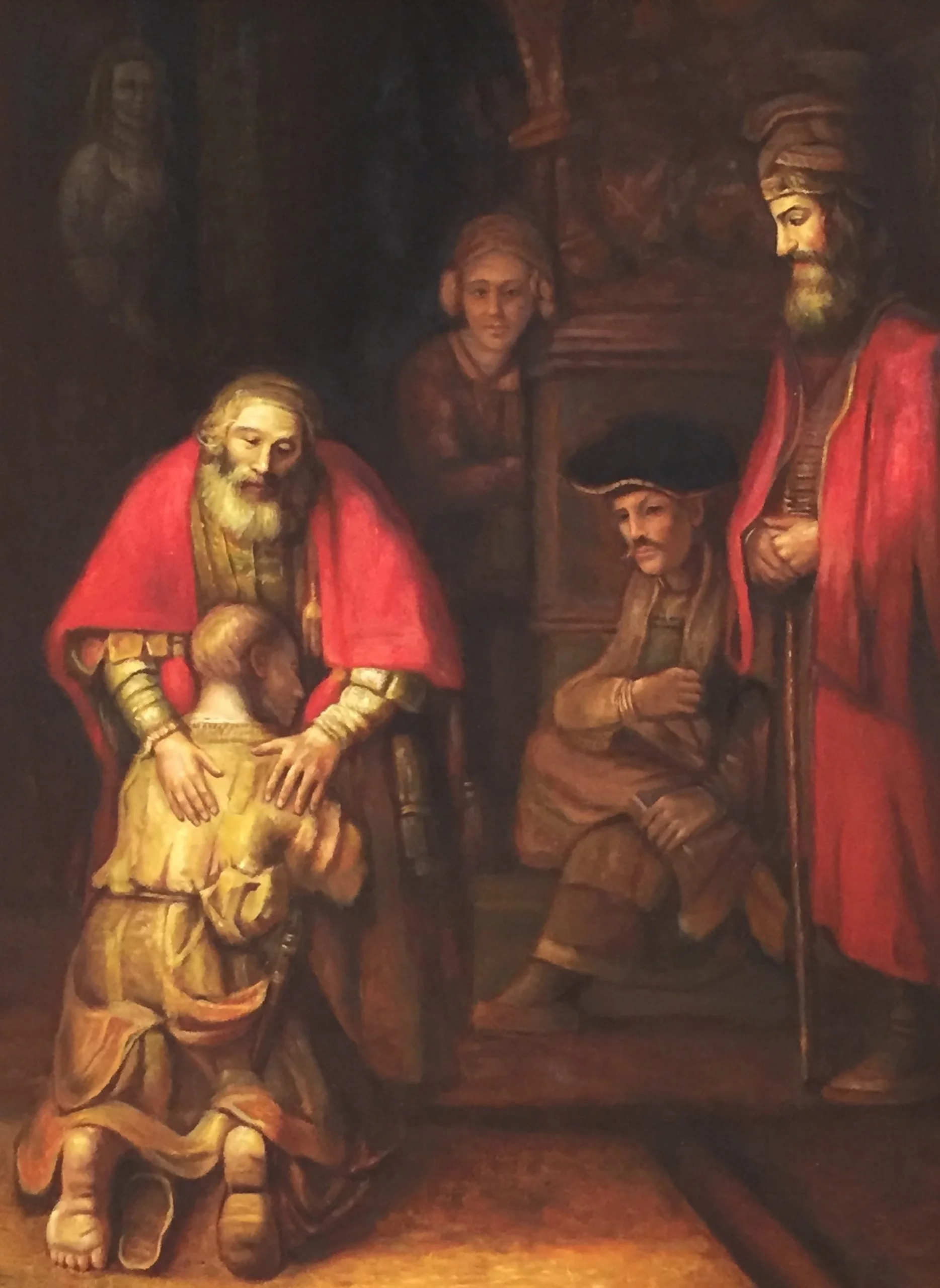
The Return of the Prodigal Son, Rembrandt, 1669
I was an art major in undergrad, which means I took more art history classes than any human should be required to sit through. And then, because God has a sense of humor, I spent an entire semester in seminary studying one painting. One. This one.
Paper after paper after paper on this. But you know what? It's become my favorite painting of all time. Not one of my favorites. My favorite. So forgive me for making you sit through a brief art history lesson right at the end of a sermon, but I've invested too much in this to not bring it up at least once.
Rembrandt painted The Return of the Prodigal Son right near the end of his life. The same year he passed away. And in the painting, the son is kneeling. His shoes are worn through. His clothes are ruined. His face is buried in his father's chest. He's come a long way to get here, and you can see it. But the part that gets me every time is the father's hands. They're resting on the son's back. One hand is firm, almost strong. The other is soft, almost tender. And the father isn't pointing back toward the pigpen. He isn't giving a lecture. He isn't reviewing the son's mistakes.
He's just holding him.
And then off to the side, almost in the shadows, Rembrandt paints the older brother. Standing. Watching. Arms stiff. He's close enough to see the grace, but he's not in it. He stayed home the whole time, did everything right on paper, and he's the one who can't enter the embrace. He's too proud to need it.
And the interesting thing about this is that so many who look at this painting instinctively identify with the younger son. We see ourselves as the one who wandered and came home.
And that's where so many of us are.
But the real challenge of the painting, and of the parable, is that God is calling us to become the one whose hands don't push away. The one whose first instinct toward the broken person isn't to correct but to hold. The one who doesn't say, "Let me tell you everything you did wrong." The one who says, "You're home. That's enough for now.” And to become that requires exactly what James has been calling for this whole passage. It requires the death of pride. It requires the end of scorekeeping. It requires a humility that only comes from having been held yourself.
That's James 4:10. You humble yourself before the Lord, and He meets you with his hands on your back. One hand strong enough to hold you. The other gentle enough to heal you.
And then, slowly, over time, those hands reshape you. Until you become the kind of person whose first instinct toward others isn't war. It's grace.
Because we serve the God who gives more grace.
So as we get ready to respond now in worship, let me encourage you - don’t treat this as just one more song before we leave. This is our answer to the text. James has exposed the rival loves that pull at the heart. He has exposed the pride that keeps us resisting God. He has exposed the divided loyalty that leaves us unstable and worn out. But then he has told us that God gives more grace. So let this next song be more than music. Let it be confession. Let it be surrender. Let it be the prayer of a heart coming home. Who else is worthy? There is no one. Only You, Jesus.
Let’s pray.
“Father, we need your help because James has a way of exposing us. And if we’re honest, we see ourselves here. We have fought. We have wanted our own way. We have blamed others while ignoring our own hearts. We have drifted. We have been proud. We have been double-minded.
But you give more grace.
So bring us low before you, not to crush us but to heal us. Show us where our desires have become ruling demands. Show us where our loyalties have drifted. Teach us to submit to you, resist the devil, draw near to you, and walk in real repentance.
And thank you for Jesus, who made peace through his blood, who welcomes sinners, and who gives grace to the humble.
We ask it in his name. Amen.”